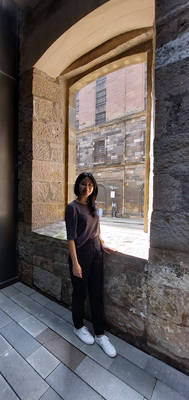
Meet Pei - our Sustainability lead & Passivhaus Designer
Pei is a Certified Passivhaus Designer and the sustainability lead at Oran Architecture with a strong commitment to sustainable, high-performance design. Through her accreditation, Pei has gained technical expertise in building physics, energy modelling using Passive House Planning Package (PHPP), and construction detailing needed to deliver buildings that meet the rigorous Passivhaus targets.
Pei is enthusiastic about translating her technical knowledge into practice and making a meaningful contribution to real-world Passivhaus and low-energy building projects. With a sharp eye for detail and a solid technical foundation, Pei believes that building design and building physics should go hand in hand in creating buildings that are not only visually striking and technically efficient, but also socially and environmentally responsible.

What is Passivhaus?
Passivhaus is an internationally proven standard for creating energy-efficient and comfortable buildings. By combining high insulation, airtight construction, efficient ventilation with heat recovery, natural daylight, and passive solar gains, it ensures superior performance while promoting health and wellbeing year-round.
The standard includes a robust quality assurance and certification process, guaranteeing real-world energy efficiency and occupant comfort. The result is reduced operational carbon, lower energy bills, and exceptional comfort and air quality.
At Oran Architecture, we advocate for Passivhaus due to its strong foundation in building physics and decades of proven success across Europe. It bridges the gap between design intent and real-world performance, delivering energy savings without compromising on beauty, resilience, or health. Passivhaus reduces energy demand through intelligent design, ensuring long-term sustainability without solely relying on renewable technologies.
Our Passivhaus Brochure
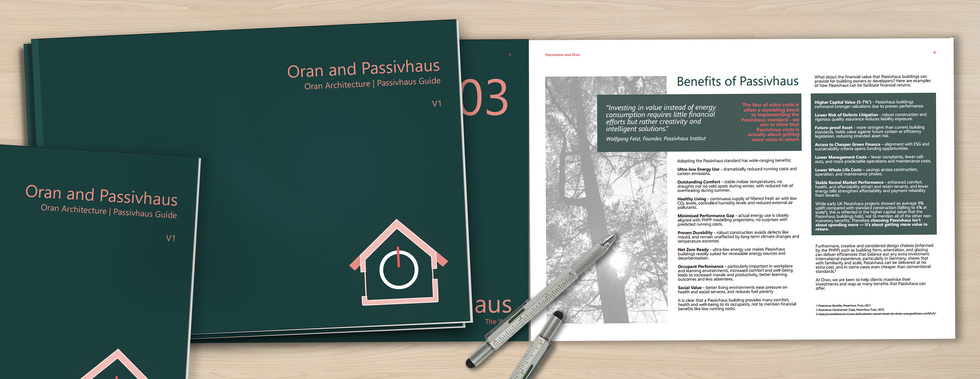
Download our Passivhaus guide HERE, for a clear practical introduction to designing high-performance, energy-efficient buildings.
Passivhaus Expertise for Large-Scale Developments
At Oran Architecture, we specialise in applying Passivhaus principles to large-scale developments, including hotels, multi-residential buildings, and student accommodations. These projects benefit from the efficiency of compact layouts, repetitive designs, and integrated systems, making them ideal candidates for Passivhaus standards.
We guide clients through every step of the Passivhaus journey, ensuring that large buildings meet the rigorous energy and comfort benchmarks while contributing to healthier, more sustainable architecture. Let us help bring your large-scale projects to life with sustainable, high-performance Passivhaus design.

Hotels
Passivhaus design suits hotels with their constant heat loads from 24/7 occupancy and appliance use. Mechanical Ventilation with Heat Recovery (MVHR) systems ensure fresh air and energy efficiency by reusing thermal energy. Service zoning allows for independent control in guest rooms and shared areas, while centralised, high-efficiency systems, supported by solar or heat pump technology, address hot water demands. This minimises operational energy use, offering long-term cost savings.

Apartment Buildings
Mid and high-rise apartment buildings are naturally suited to Passivhaus due to their compact form and shared walls. Vertical service cores streamline construction and services, while an optimised envelope enhances airtightness and thermal performance. Careful glazing ensures daylight and views without sacrificing comfort. Prefabricated construction methods improve build quality and delivery, ensuring consistent performance.

Student Accommodation
Passivhaus principles suit student housing, combining benefits of hotels and apartments. Controlled environments enhance health, wellbeing and focus, while standardized layouts streamline airtightness and insulation. This consistency reduces performance gaps, lowers energy demand, and delivers long-term operational savings for educational institutions and operators managing student-focused developments.